Samuel Laing
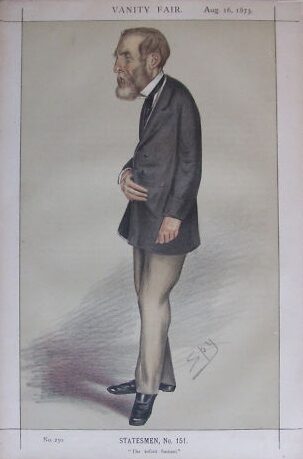
| Born | 12 December 1812, Edinburgh |
|---|---|
| Died | 6 August 1897, Sydenham |
| Elections | 4 (3 won) |
| Bayanne | Genealogy page |
Samuel Laing was a railway administrator, Member of Parliament for Orkney and Shetland, and writer on science and religion during the Victorian era.
Biography
Early life
Samuel Laing was born on 12 December 1810 in Edinburgh, Scotland. He was the nephew of Malcolm Laing, the historian of Scotland; and his father, also called Samuel Laing (1780–1868), was a well-known author, whose books on Norway and Sweden attracted much attention. Samuel Laing the younger entered St John's College, Cambridge in 1827, and after graduating as Second Wrangler and Smith's Prizeman, was elected a fellow. He remained at Cambridge temporarily as a coach, before being called to the bar in 1837.
Career
He became private secretary to Henry Labouchere, later 1st Baron Taunton, who was then the President of the Board of Trade. In 1842, he was made secretary to the railway department, and retained this post until 1847. He had by then become an authority on railways, and had been a member of the Dalhousie Railway Commission; it was at his suggestion that the "parliamentary" rate of a penny a mile was instituted. In 1848, he was appointed chairman and managing director of the London, Brighton and South Coast Railway (LB&SCR), and his business acumen showed itself in the largely increased prosperity of the line. He also became chairman (1852) of the Crystal Palace Company, but retired from both posts in 1855. In 1852, he was elected to Parliament as a Liberal Party candidate in Wick Burghs. After losing his seat in 1857, he was re-elected in 1859, and appointed Financial Secretary to the Treasury; in 1860 he was made finance minister in India. On returning from India, he was re-elected to parliament for Wick in 1865. He was defeated in 1868, but in 1873 he was returned for Orkney and Shetland, and retained his seat till 1885. Meanwhile he had been reappointed chairman of the Brighton line in 1867, which was now on the point of bankruptcy following the over-ambitious expansion plans of the previous chairman. He continued in that post until 1896, and gradually restored the company to financial health. He was also chairman of the Railway Debenture Trust and the Railway Share Trust. Although often claimed to have been the father of the novelist Mary Eliza Kennard (1850–1936), this is incorrect.
Later Life
In later life, he became well known as an author, his Modern Science and Modern Thought (1885), Problems of the Future (1889) and Human Origins (1892). Laing's attitude was generally positive towards new developments in science, and he offered an optimistic vision of progressive modernity. He also wrote on religion. His book A Modern Zoroastrian argued that the ancient religion of Zoroastrianism was more consistent with modern scientific thought than was traditional Christianity. He argued that the "all pervading principle of polarity" that was central Zoroastrian thought has been confirmed by science, and that modern Christianity should abandon its traditional theology to centre on the figure of Jesus as an ideal of humanity.
Political Career
| Year | Election | Council | Votes | Result |
|---|---|---|---|---|
| 1832 | 1832 UK General Election, Orkney and Shetland Result | Parliament of the United Kingdom | 96 | Not elected |
| 1873 | Orkney and Shetland by-election, 1873 | Parliament of the United Kingdom | 646 | Elected |
| 1874 | 1874 UK General Election, Orkney and Shetland Result | Parliament of the United Kingdom | Unopposed | |
| 1880 | 1880 UK General Election, Orkney and Shetland Result | Parliament of the United Kingdom | 896 | Elected |